Impacts of Different Tillage Systems on Soil Health
January 21, 2026
Although tillage has been an important part of crop production for generations, today’s farmers face an increased need to improve soil health, manage water more effectively, and reduce erosion. Conservation tillage systems, such as no-till and reduced-till, are gaining more traction as proven alternatives to conventional tillage practices.
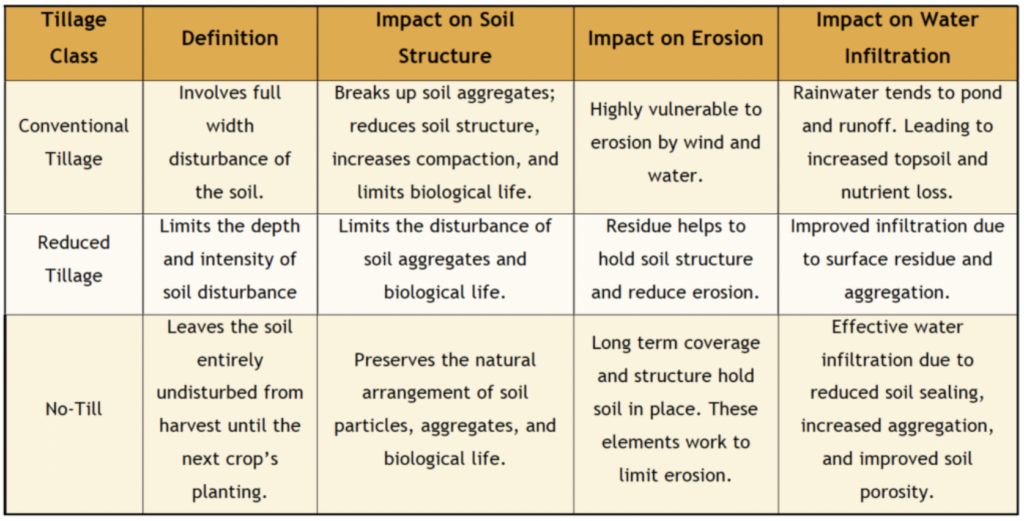
This article highlights common tillage practices, and the effect it can have on soil properties (Figure 1).
Defining Conventional, Reduced, and No-Till Systems
Conventional tillage involves full-width disturbance of the soil. Tools like moldboard plows, discs, and field cultivators are used to turn and mix the soil completely. This system generally leaves less than 15% crop residue on the surface. Conventional tillage effectively creates a clean seedbed but can negatively affect soil structure and moisture retention with overuse.
Reduced tillage limits the depth or intensity of soil disturbance and leaves more residue on the surface, typically between 15% and 30%. It can involve shallow disking, chisel plowing, or other methods that limit the disturbance of soil aggregates yet still provides an effective method for weed management.
No-till leaves the soil entirely undisturbed from harvest until the next crop’s planting. Seeds are planted directly through stubble from the previous crop, with more than 30% of the surface cover remaining. The use of minimal disturbance tools, such as a knife-style opener on seeding equipment, may be advantageous in no-till systems when residue management is necessary.
Soil Structure and Aggregate Stability
One of the key differences between tillage systems lies below the surface of the soil. Each tillage system influences the physical & biological properties of a soil; these differences are highlighted below.
Conventional tillage breaks up soil aggregates, which are clusters of sand, silt, and clay particles bound together by organic matter and microbial byproducts. While breaking these aggregates apart loosens the seedbed temporarily, repeated tillage reduces long-term soil structure, increases compaction, and limits biological life.
No-till and reduced-till systems help preserve, or even build, aggregate stability over time. Organic matter stays closer to the surface, where it can support microbial activity and act as a natural stabilizer for particles. Over several seasons, soils under reduced disturbance systems become more porous, resilient, and biologically active. Increased biological activity includes earthworms, fungi, and beneficial bacteria breaking down plant material. Improving the soil biosphere helps cycle nutrients, increase root growth, and improve long-term fertility.
Water Infiltration
In tilled fields, soil compaction and crusting can reduce water infiltration. Rainwater tends to pond or run off, especially during heavy rainfall events. This increases the risk of surface erosion, nutrient loss, and more water stress in the soil during dry spells.
No-till systems dramatically improve water infiltration by maintaining surface residue, avoiding compaction, and increasing organic matter. Rain hits the residue first, reducing surface sealing and giving water more time to soak in to the soil. Root channels and biological pores also enhance downward movement of water.
Reduced tillage offers similar improvements as no-till systems, though the benefits depend on tool selection, operating depth, and residue management.
Erosion
Due to the destruction of soil aggregates and fragmented structure, conventionally tilled fields are highly vulnerable to erosion by water and wind. Over time, this can lead to significant topsoil loss, along with the organic matter and nutrients it contains.
Residue left on the field in reduced-till or no-till systems helps protect the soil from raindrop impact and surface flow. In no-till systems, long-term residue and cover cropping build soil structure that resists erosion even during extreme rainfall events.
Steep slopes, fine-textured soils, and high-rainfall regions are particularly vulnerable to erosion, making conservation tillage a beneficial practice in these environments.
Management Considerations
There is a common misconception that reducing tillage can negatively impact yields, especially during the early years of transition to fewer (or zero) passes. You may see initial changes in weed pressure or nutrient requirements in certain crop rotations, but yields have been shown to be equal to, or better than, conventionally tilled crops over the long term.
With the implementation of new tillage practice, whether no-till or reduced till, comes an increased need for careful monitoring of soil fertility, pest populations (weeds, insects, and diseases), and cover crop performance. The long-term goal of reducing tillage looks to decrease input & fuel costs, while increasing soil biological activity and organic matter, preserving soil moisture, and improving the overall quality of the soil. By noting small changes or successes each season, you can build a strong agronomic plan to create the most profitable system for your farm.
The right system will depend on your soil type, equipment, crop rotation, and management goals, but conservation tillage and no-till have proven themselves as a reliable foundation for long-term productivity and sustainability.
Citations
No-till reduced and conventional tillage: A cheat sheet for farmers. Farmers Business Network. (2025, April 9). https://www.fbn.com/community/blog/no-till-reduced-conventional-tillage-cheat-sheet
USDA. (n.d.). Residue and tillage management, reduced till. https://www.nrcs.usda.gov/sites/default/files/2022-09/Residue_And_Tillage_Management_Reduced_Till_345_CPS.pdf